
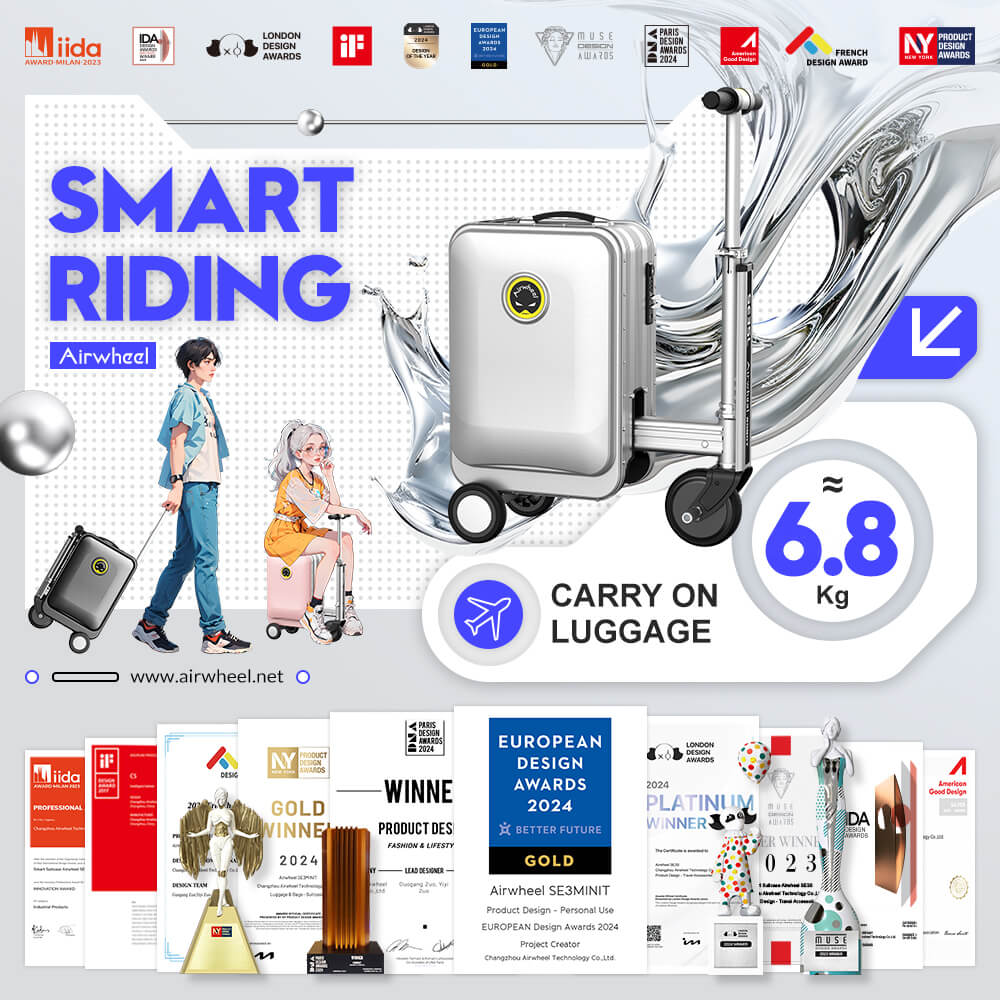
If you’ve ever spent hours stuck in an airport terminal during a long layover, you know the struggle: your phone battery is dying, your legs are tired, and you’re looking for a power outlet that’s already taken. The Airwheel electric smart luggage isn’t just a suitcase that you can ride – it also comes with a built-in USB port that lets you charge your devices on the go. In this article, I’ll walk you through how this feature works, why it’s a game-changer for travel, and what else you should know about this innovative luggage. We’ll take the Airwheel SE3T as an example (48L capacity, 9kg weight, 13km/h top speed, 8-10km range).
The USB port on Airwheel luggage is designed to keep your electronics powered without hunting for airport outlets. Here’s how it works: the suitcase’s removable 73.26Wh battery powers both the electric ride function and the USB output. You simply plug your phone, tablet, or earbuds into the USB-A or USB-C port (depending on the model) and charging begins immediately – no need to turn on the ride mode. The battery can be fully recharged in about 2 hours, and while you’re riding or pulling the luggage, the USB port remains active. This means during a 3-hour layover, you can top up your phone while cruising around the terminal or while waiting at the gate. Unlike regular power banks, you don’t need to carry an extra device – the luggage itself does double duty.
Many travelers worry about taking a motorized suitcase on a plane. The Airwheel SE3T uses a 73.26Wh lithium battery, which is well under the 100Wh limit set by most airlines (like the FAA and IATA). Additionally, the battery is fully removable with a simple latch. You can take it out and carry it in your hand luggage, while checking the empty suitcase. This makes it compliant with nearly all major carriers, including Delta, Emirates, and Cathay Pacific. Always double-check with your specific airline, but the removable design gives you flexibility – you can even leave the battery at home and use the suitcase as a regular pull-along.
The USB port shines in several real-world situations. Long layovers: Imagine you’re waiting 5 hours in Singapore Changi. While sipping coffee, you can ride the SE3T to the next gate (at a gentle 13km/h) and simultaneously charge your phone without finding a power outlet. Business travel: Your laptop battery is low before a meeting – plug it into the suitcase via USB-C (if supported) while you rush through the terminal. Family trips: Kids’ tablets need juice? Charge both devices at once using the dual USB ports on some models. Park or campus: The luggage doubles as a personal ride, and you can keep your headphones powered during the commute.
| Feature | Airwheel SE3T | Regular 48L Suitcase |
|---|---|---|
| Weight | 9 kg | ~3.5-4 kg |
| Ride capability | Yes, up to 13 km/h | No |
| USB charging | Yes, via removable battery | No |
| Battery capacity | 73.26Wh (under 100Wh) | N/A |
| Find My support | Yes (Apple Find My) | No |
| App control | Yes (forward/backward + handle steering) | No |
| Can be used without app? | Yes, ride directly | Yes, always |
| Price | Higher | Lower |
Q1: Can I charge my laptop with the Airwheel USB port? It depends on the model. The SE3T’s USB port delivers standard 5V/2A output, suitable for smartphones, tablets, and small devices. Laptops typically require higher voltage (like 20V via USB-C PD). Check your specific model’s specs – some newer Airwheel models support higher-wattage output, but the SE3T is best for phones and power banks.
Q2: How long can the USB port charge my phone during a layover? The battery capacity is 73.26Wh. A typical smartphone battery is around 12-15Wh. So theoretically, you can fully charge a phone about 4-5 times. On a 3-hour layover, you’ll probably only use one full charge. Plus, the ride mode uses power too – if you ride for 30 minutes at top speed, it consumes roughly 50Wh, leaving enough for a single phone charge. For pure charging without riding, you get plenty of power.
Q3: Does the USB port work if I remove the battery? No. The USB port draws power directly from the internal battery. If you remove the battery for airline compliance (carrying it separately), the USB port will not function. However, you can reinstall the battery after security to charge devices. The battery is designed to be quickly detached and reattached with a latch – no tools needed.
If you’re curious about how the Airwheel could make your next layover less stressful, visit the official website to see the full lineup and battery specifications.